Executive Functioning
Updated: Aug 25, 2019
Executive Functioning is one of those terms that up until a few years ago, was very much discussed solely when referencing students for whom an Ed Psych assessment had been administered. This was, of course, as Executive Functioning was one of the many areas assessed.
I have noticed that in recent years, Executive Functioning is a concept that is being referenced more broadly. Cooper-Kahn and Dietzel define Executive Functions as “a set of processes that all have to do with managing oneself and one's resources in order to achieve a goal. It is an umbrella term for the neurologically-based skills involving mental control and self-regulation” (taken from: What Is Executive Functioning?).
Executive Functioning is comprised of various elements, including but not limited to planning/prioritizing, organization, time management, task initiation, working memory, self-control and flexibility. (See below for examples of Executive Functioning skills summary and explanation/examples).
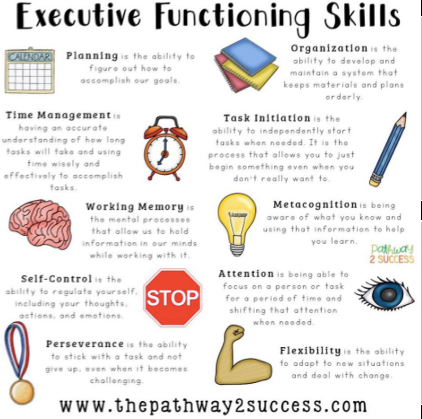

Below are brief summaries/extracts of some interesting articles regarding Executive Function:
A Day in the Life of a Child with Executive Functioning Issues clearly articulates the day to day reality and how Executive Functioning impacts (or can impact) a child in many ways with regards to academics and social interactions.
In Organizing Students for Learning, Finley highlights ten tips for organization which will benefit all students and especially those who struggle with Executive Functioning.
In Brain Development and Adolescent Growth Spurts, Willis references the importance of strengthening Executive Functioning skills during early adolescence with the view that “the tools and skills that you help them build will empower them to achieve their highest potential now, and will increase their satisfaction and success as they inherit the challenges and opportunities of the 21st century”.
Why Executive Function Is A Vital Stepping-Stone For Kids' Ability to Learn includes some strategies to implement in the classroom. The purpose of these strategies, such as brain breaks, breathing exercises, keeping fidget toys on hand for students to aid concentration as and when necessary, and the use of calming music during transition times is to help students learn how to regulate themselves within the regular classroom.
The role of Executive Functioning is clearly stated in both the title, Executive Function Deficits Determine Student Achievement, and the opening paragraph of the article: “Difficulties in math and science learning in the early grades can have lasting consequences for students who have impairments in executive functions …. The research looks back at executive functions related to working memory, cognitive flexibility and inhibitory control to determine when problems begin in early STEM education.”
In Executive Skills and the Struggling Reader, Cartwright discusses the impact of executive skills on reading and - mindful that “reading comprehension is the foundation for all other learning in school”, states, “students cannot understand, enjoy, or respond to literature without effective reading comprehension; likewise, students cannot gather new information from science, math, or social studies texts when they don’t understand what they read”.
In what way does your school setting help students, and especially those who struggle with Executive Functioning skills, develop these critical skills for success in the now and future?


Comments